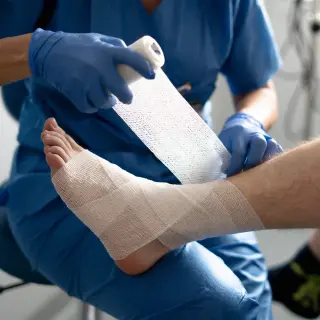
Malignant Wound Care
Control of exudate, odour, bleeding and pain in tumour-related wounds, alongside — and never in place of — the patient's cancer treatment.
About this treatment
A malignant wound is a wound whose cause is a tumour — either a tumour that has reached and broken through the skin, or a wound at a surgical site or following radiotherapy. That difference changes everything: while the underlying cause is present, closing the wound is not necessarily the goal. The goal is controlling the things that have made daily life hard for the patient and their family. We say so from the outset, so that no false expectation is created.
Four things place the greatest burden on the patient: exudate, odour, bleeding and pain. Each has something specific that can be done. Heavy exudate is managed with absorbent dressings, both to protect the surrounding skin and to spare the patient constant changes. Odour — often the part patients find hardest, and the reason they withdraw from company — can usually be reduced substantially by controlling the wound's microbial burden, choosing the right dressings, and treatment under a physician's supervision.
Bleeding during dressing changes is a family's constant fear, and its cause is the fragility of tumour blood vessels. The answer is a non-adherent dressing, moistening the dressing before removal, and changing it gently without pulling. Pain is considered at every stage of care, and dressing changes are timed around the patient's analgesia.
This care does not replace cancer treatment and does not alter the patient's oncology plan; it runs alongside it, in coordination with the treating physician. One thing to add for families: at this stage, comfort and the patient's dignity are themselves serious treatment goals, not something at the margins of care. For patients who cannot easily travel, this care is also available at home.
Your treatment path at Dialine
- 1Assessment of the wound, exudate, odour and bleeding
- 2Absorbent dressings matched to the volume of exudate
- 3Microbial burden and odour control under a physician's supervision
- 4Non-adherent dressings, changed gently and without pulling
- 5Care of the peri-wound skin against constant exudate
- 6Dressing changes timed around pain control
- 7Teaching care to the family and the patient's companion
Frequently asked questions
What is the goal of malignant wound care?
Controlling the symptoms that have made daily life hard — exudate, odour, bleeding and pain — and preserving the patient's comfort and dignity. While the underlying cause is present, complete closure is not necessarily a realistic goal, and we say so from the outset.
Does this replace cancer treatment?
No. Wound care runs alongside cancer treatment, in coordination with the treating physician, and does not alter the oncology plan. Treatment of the disease itself remains with the oncology team.
Can the wound's odour be controlled?
In many cases yes, and often noticeably. Odour is reduced by controlling the wound's microbial burden, choosing suitable dressings and, where a physician prescribes them, topical treatments. For many patients this single change makes the greatest difference to quality of life.
Why does the wound bleed during dressing changes?
Because the new vessels in tumour tissue are fragile and tear at the slightest pull. Using a non-adherent dressing, moistening it before removal and changing it gently do most to prevent that bleeding.
Can this care be provided at home?
Yes. For patients who cannot easily travel to the clinic, wound care is available at home, and care between visits is taught to the family.
Other services