Chronic wound healing is multidimensional. Wound bed preparation, articulated as the TIME framework by Schultz et al. in 2003, is the global standard. In practice, dressing choice is inseparable from specialist chronic wound care: every dressing follows an assessment of the wound bed.
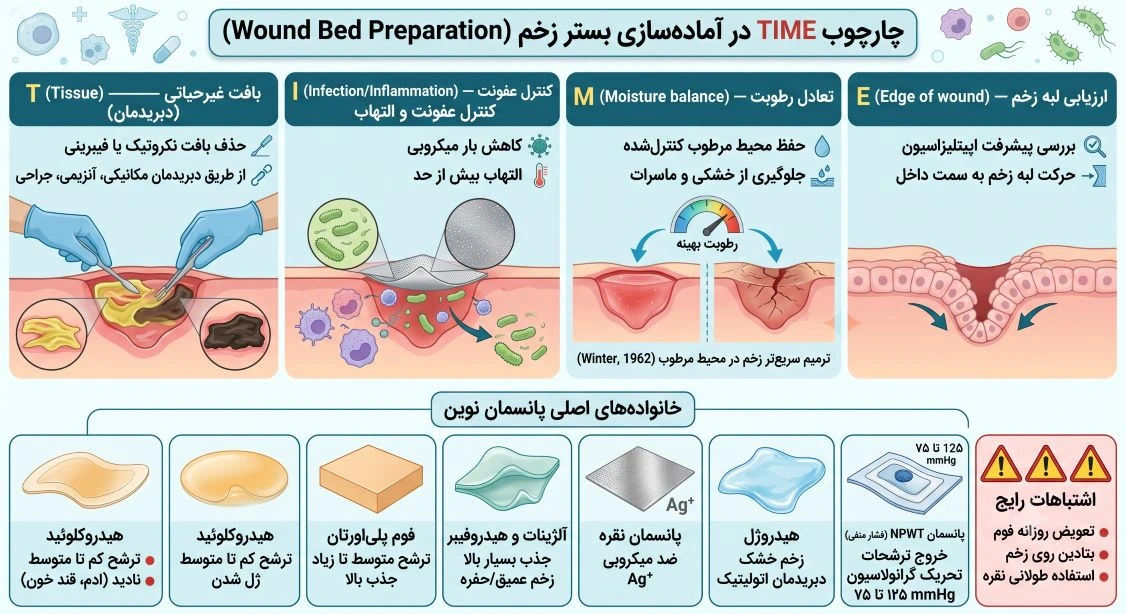
TIME
- T — Tissue: debride necrotic and slough tissue.
- I — Infection/Inflammation: control bioburden.
- M — Moisture balance: avoid both desiccation and maceration.
- E — Edge: monitor epithelial advancement.
Dressing families
- Hydrocolloid — superficial, low-to-moderate exudate.
- Polyurethane foam — moderate-to-high exudate, pressure offloading.
- Alginate / hydrofiber — cavities, heavy exudate, mild haemostasis.
- Silver — local infection or high bioburden, short courses only.
- Hydrogel — dry wounds, autolytic debridement.
Negative-pressure wound therapy (NPWT)
Topical negative pressure (75–125 mmHg) accelerates granulation in complex wounds. Cochrane review (2018) found moderate evidence for faster closure after partial diabetic foot amputations. A Accident wounds often fall into this same category of deep, contaminated wounds; leg wounds after an accident and how they heal is covered separately.real NPWT case from Dialine is in the treatment gallery.
References
- Schultz GS, et al. Wound bed preparation: a systematic approach. Wound Repair Regen. 2003;11(Suppl 1):S1–S28. https://doi.org/10.1046/j.1524-475X.11.s2.1.x
- Winter GD. Formation of the scab and the rate of epithelization. Nature. 1962;193:293–294. https://doi.org/10.1038/193293a0
- Liu Z, et al. NPWT for foot wounds in diabetes. Cochrane Database Syst Rev. 2018;10:CD010318. https://doi.org/10.1002/14651858.CD010318.pub3