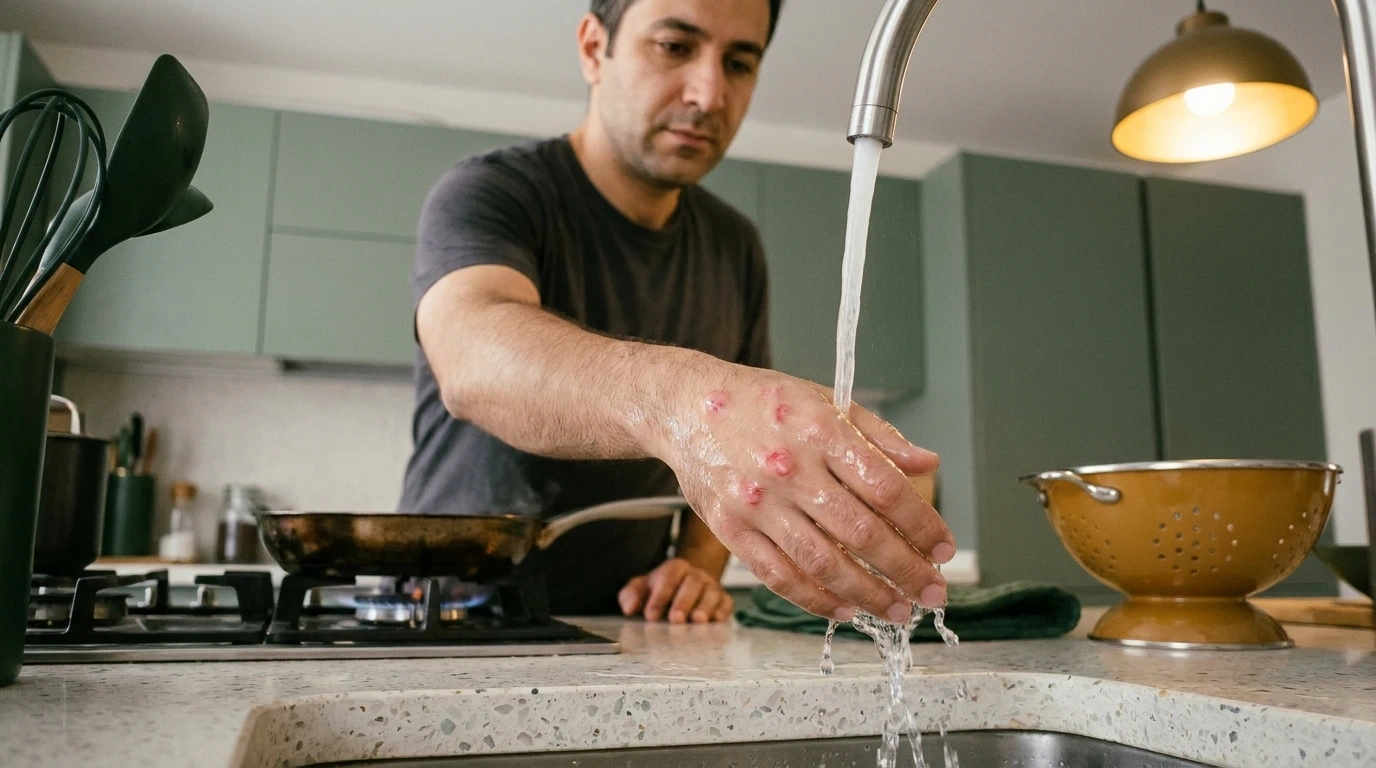
The hot plate of an iron brushed your forearm for a second. Getting off the back of a motorcycle, your calf touched the exhaust. Or a few drops of oil jumped out of the pan onto your hand. The burn is small and does not hurt much at first, so many people decide it is nothing and carry on.
Right now, hold the burn under cool running water for twenty minutes; not ice water. Then know this: burns from an iron, a motorcycle exhaust or hot oil are often deeper than they look, because hot metal and hot oil carry more heat and stay on the skin. Go to an emergency department the same day if the centre of the burn has turned white, grey or brown and does not hurt; if it has blistered on a hand, foot, the face or a joint; or if it is bigger than your own hand. Oil in the eye and any burn on a child cannot wait either. Below we explain why, and what to do for each of these three causes.
Right now, for all three
The main rule is the same for all three. Stop the contact with the heat and hold the burn under cool running water for about twenty minutes. This still helps up to about three hours after the burn, so if you remember late, do it anyway. Take off rings, watches and bracelets before the area swells, then cover the burn with something clean and non-stick. In the first minutes after a burn we list the home remedies, such as ice, toothpaste and butter, that make a burn worse.
Each cause also has its own point:
- Hot oil: do not wipe the oil off with a tissue or rub it into the skin; put the burn straight under the water. If oil has soaked into clothing, take the clothing off, because oily fabric holds the heat against the skin. Do not pull off clothing that has stuck to the skin.
- Iron: first unplug the iron and put it where a child cannot reach it or its cord.
- Motorcycle exhaust: get off and hold the leg under cool water. Do not burst a blister that has formed.
Why these burns are deeper than they look
Two things decide how deep a burn goes: how hot the thing that touched the skin was, and how long it stayed there. The more heat and the longer the contact, the deeper into the skin the damage reaches.
Hot metal, such as the plate of an iron or an exhaust pipe, holds a great deal of heat and passes it to the skin through direct contact. Hot oil gets much hotter than boiling water, and because it is thick, it clings to the skin and is slow to wash off. That is why an oil burn is usually more severe than a scald from hot water.
Anyone who pulls away more slowly gets a deeper burn: a child who does not understand what is happening, an older person who moves slowly, and someone whose feet have lost feeling. If you have diabetes, also read burns on the foot in diabetes.
The true depth of a burn can also take a few days to show. A burn that was only red on the first day may blister or change colour a few days later. So if it is not getting better, look at it again.
Iron burns
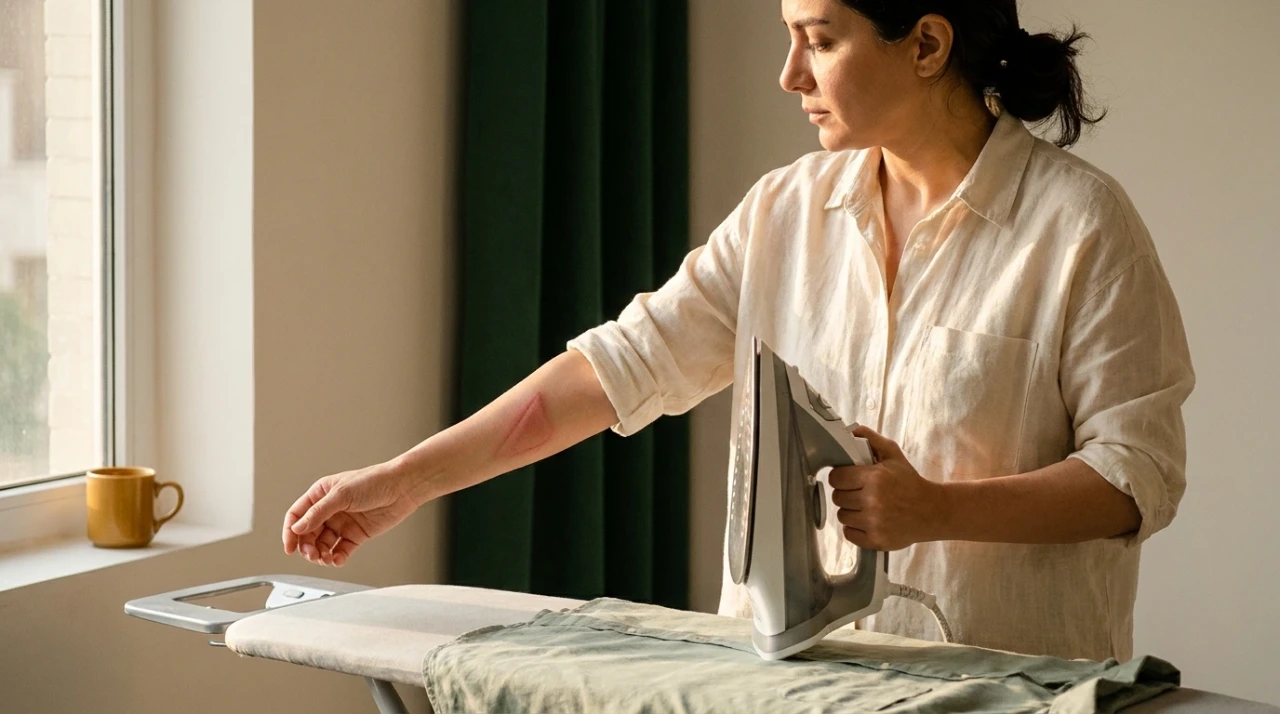
Iron burns are most often on the forearm, the back of the hand and the fingers, the places that come close to the iron while smoothing clothes. The mark usually has the shape of the iron itself: a straight edge or a pointed tip, with a clear border. If the skin is only red and painful, the burn is superficial. If it blisters, it has reached a deeper layer.
Irons carry another risk for children. A child pulls on the cord and the hot iron falls onto their hand or face. A burn on a child, however small, should be seen by a doctor.
Take a blister on the hand or fingers seriously. The hand is a sensitive area, and a blistering burn there should be seen in an emergency department first. Dressing changes and follow-up can then continue at a clinic.
Motorcycle exhaust burns
The usual place is the inner side of the lower leg, a little above the ankle. It usually happens to someone riding pillion, or whose leg touched the pipe while getting off. It is more common in summer, with shorts and skirts, and children are often affected.
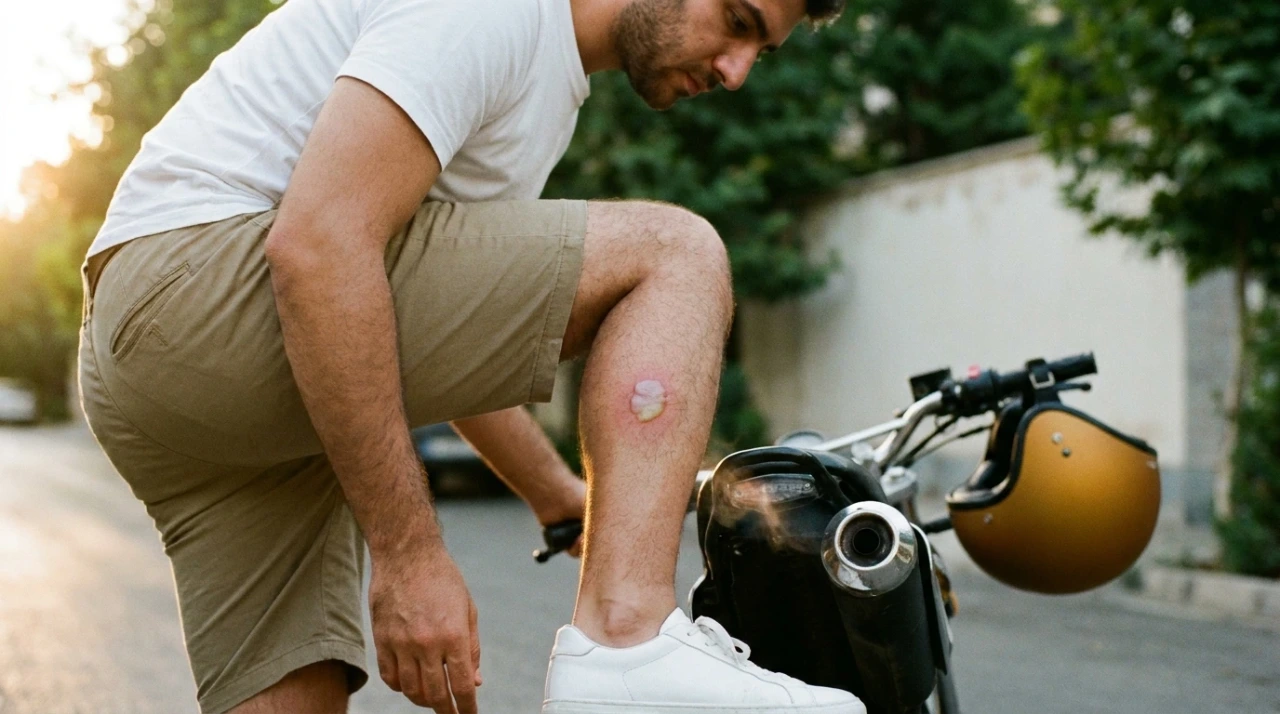
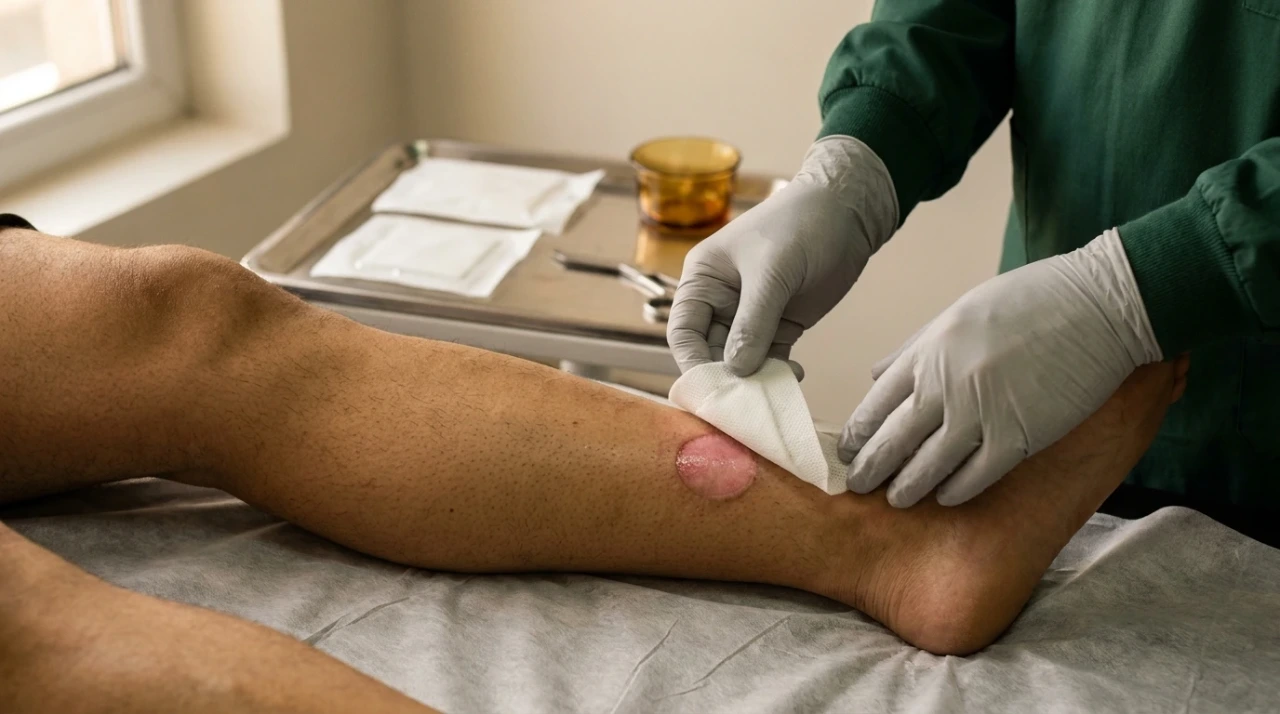
The burn is small and round, and often starts as a blister or a white patch. That small size is misleading. An exhaust pipe is very hot and the skin sometimes sticks to it for a moment, so the damage reaches deeper layers of the skin and the wound heals more slowly than a superficial burn.
Do not burst the blister of an exhaust burn or put anything on it. This burn is on the leg, and a blistering burn on the leg should be seen by a doctor the same day. If you come to us for dressings after the emergency department, or if the burn has still not closed after about two to three weeks, we follow it up at the clinic.
Prevention is simple: a heat shield on the exhaust, long trousers for whoever rides pillion, and getting off on the side without the exhaust.
Hot oil burns
Oil usually splashes rather than spills. A few drops land on the back of the hand, the forearm, the neck or the face, and each one makes a small burn of its own. If a pan or a deep fryer tips over, it causes a larger burn, usually on the abdomen, thigh or leg.
Oil is hotter than boiling water and stays on the skin, so an oil burn is usually deeper than a burn from hot water. Small drops that leave only redness usually heal at home with cool water and a clean covering. But a large blister, a burn on the face and a widespread burn should be seen by a doctor.
Oil in the eye: if hot oil splashes into the eye, rinse the eye with clean, cool water and go to an emergency department without delay. Do not rub the eye.
Fire and flames: when to go straight to the emergency department
Burns from fire, for example when clothing catches fire or a flame flares up from a gas stove or heater, are usually larger and deeper than the burns in this article. If someone's clothes catch fire, have them lie on the ground and roll until the flames go out, or put the fire out with a blanket. Then hold the burn under cool water.
These burns are not for an outpatient clinic; they belong in an emergency department or a burns unit: a widespread burn, a burn on the face, a burn that goes all the way around an arm or leg, electrical and chemical burns, and any burn that came with smoke inhalation. If you are looking for real photographs of burns and their treatment, see real burn treatment photos at Dialine.
When to see a doctor the same day
With any of these signs, have the burn seen in an emergency department the same day:
- The centre of the burn has turned white, grey, leathery or brown.
- The burn does not hurt, or the area is numb. That is not a good sign.
- The burn is bigger than the hand of the person who was burned.
- It has blistered on the face, a hand, a foot, a joint or the genitals.
- Oil has splashed into the eye.
- The person who was burned is a child or an older adult.
A small, superficial burn can be cared for at home. But if you have diabetes, if after a few days the redness and pain have increased, if pus or a bad smell has appeared, or if the burn has still not closed after about two to three weeks, show it to a doctor. We list the signs of infection in full in signs of an infected burn.
Will an iron or exhaust burn leave a mark?
A superficial burn usually heals without a mark, or with a faint one. A deeper burn, and a burn that took a long time to close, is more likely to leave a mark. Because iron and exhaust burns are often deeper, they are more likely to leave one.
Two things are in your hands. First, that the wound closes on time and properly; the right dressing and regular follow-up play their part in that. Second, that you keep the new skin out of the sun for months, because sunlight darkens new skin and that darkening is slow to fade.
A burn mark takes months to reach its final colour and texture. If its colour differs from the rest of your skin, or it has become raised and firm, we explain each case in the colour of a burn scar and a raised burn scar. For treatment, see burn scar and scar treatment at Dialine.
Burn wound care at Dialine
A widespread or deep burn belongs in a hospital and its burns unit. Our work at Dialine is burn wound care: from the first day for a limited burn, after discharge for continued dressings, and for a burn that has not closed after weeks.
- Assessing the degree and extent of the burn
- Cleaning the wound
- Removing dead tissue where appropriate (debridement)
- Advanced dressings, matched to the burn's drainage and depth
- Watching for signs of infection, and timely referral
- Scar care once the wound has closed: silicone gel and sheets, and sun protection
- Teaching home care and the warning signs
Dialine works in four areas: diabetes, chronic wounds, scars and neuropathy. More details at burn wound treatment at Dialine.
Frequently asked questions
What degree is an iron burn?
It depends on how hot the iron was and how long it stayed on the skin. If the skin is only red and painful, it is a superficial (first-degree) burn. If it has blistered, it is second-degree. If the skin has turned white or leathery and does not hurt, it may be deeper and should be seen the same day. The degree cannot be judged reliably from a photo. Each degree is explained in first-, second- and third-degree burns.
What should I put on a hot oil burn?
Nothing but cool water. Hold it under cool running water for twenty minutes, then cover it with something clean and non-stick. Do not put any home remedy on the burn, not even oil or butter. If the burn needs a particular ointment or dressing, a doctor will say so after seeing it.
Should I burst the blister from an exhaust burn?
No. The roof of the blister protects the skin underneath from contamination. Do not burst the blister or peel off its skin. If the blister is large or has burst on its own, a doctor will decide what to do with it. Read more in blisters: burst them or not?
Why is an exhaust burn slow to heal?
Because it is often deeper than it looks. The pipe is very hot and the contact sometimes lasts a moment, so the deeper layers of the skin are damaged too. A deep burn heals more slowly and is more likely to become infected and to leave a mark. If it has not closed after about two to three weeks, show it to a doctor.
Hot oil splashed into my eye. What should I do?
Rinse the eye with clean, cool water, hold the eyelids open so the water reaches the whole eye, and do not rub it. Then go to an emergency department without delay, even if the pain eases. A burn to the eye must be seen by a doctor.
Will an iron burn mark go away?
If the burn was superficial, it usually fades with time and sometimes disappears completely. If it was deeper, a mark may remain. During the months while the mark is still changing, keep it out of the sun. If it becomes raised and firm, or still bothers you months later, show it to a doctor; a recent scar usually responds better to treatment.
My child touched a hot iron. Where should I take them?
First hold the hand under cool water for twenty minutes, not ice water, and keep the rest of the child warm. A burn on a child, however small, should be seen by a doctor. If it has blistered, is on the face or a hand, or is bigger than the child's own hand, go straight to an emergency department. Dressings after the emergency visit can continue at a clinic.
Burn not healing? Let us take a look
If your burn has not improved after a few days, if you are looking for a reliable place to continue dressings after an emergency visit, or if the mark is worrying you, book an appointment to have the burn assessed. Dialine is in Pasdaran, Tehran, and you can book by phone, Instagram DM or WhatsApp.
References
- ISBI Practice Guidelines Committee. ISBI Practice Guidelines for Burn Care. Burns, 2016.
- World Health Organization. Burns (fact sheet). 2023.
- Moritz AR, Henriques FC. Studies of thermal injury II: the relative importance of time and surface temperature in the causation of cutaneous burns. American Journal of Pathology, 1947.
- Burns from motorcycle exhausts among children in New South Wales: a continuing problem. Medical Journal of Australia, 2013.
- NHS. Burns and scalds: treatment. nhs.uk.
This article is not a substitute for an in-person medical consultation.