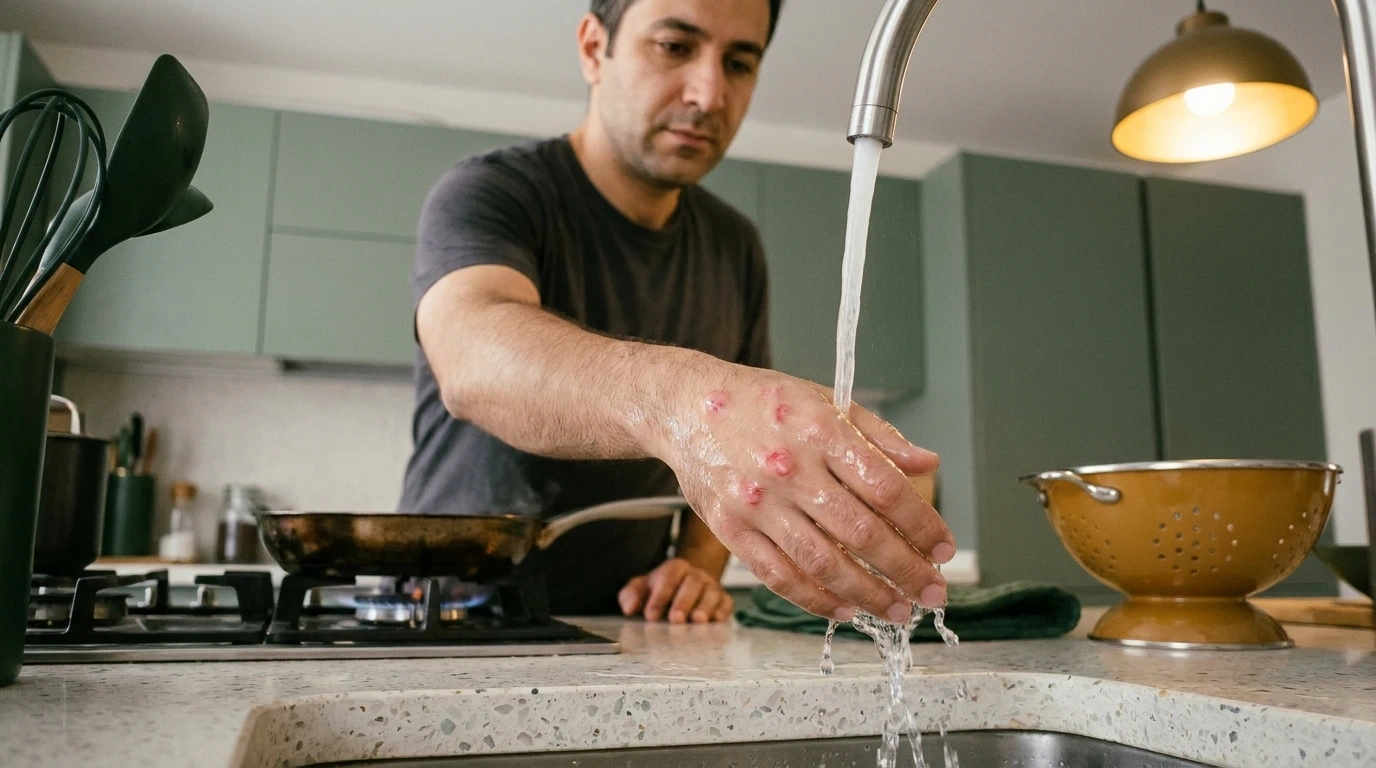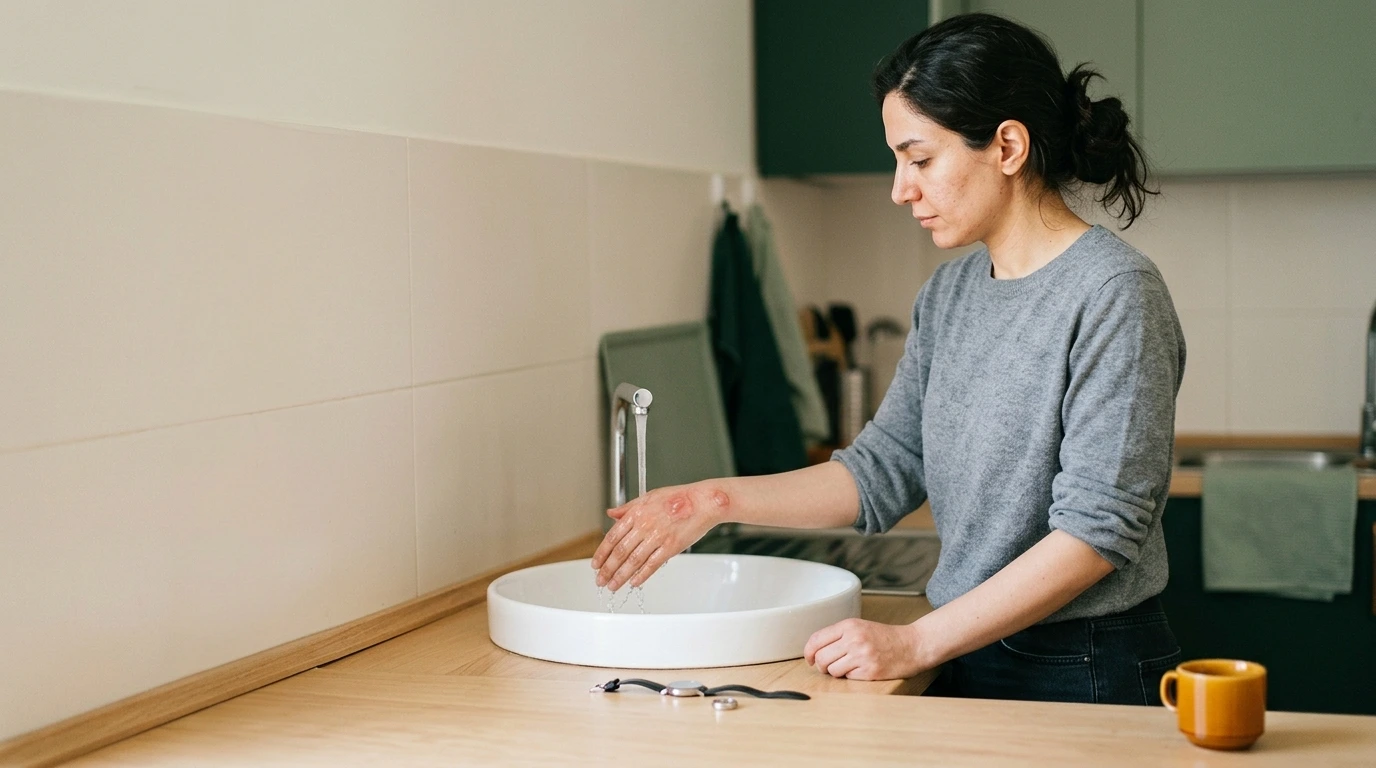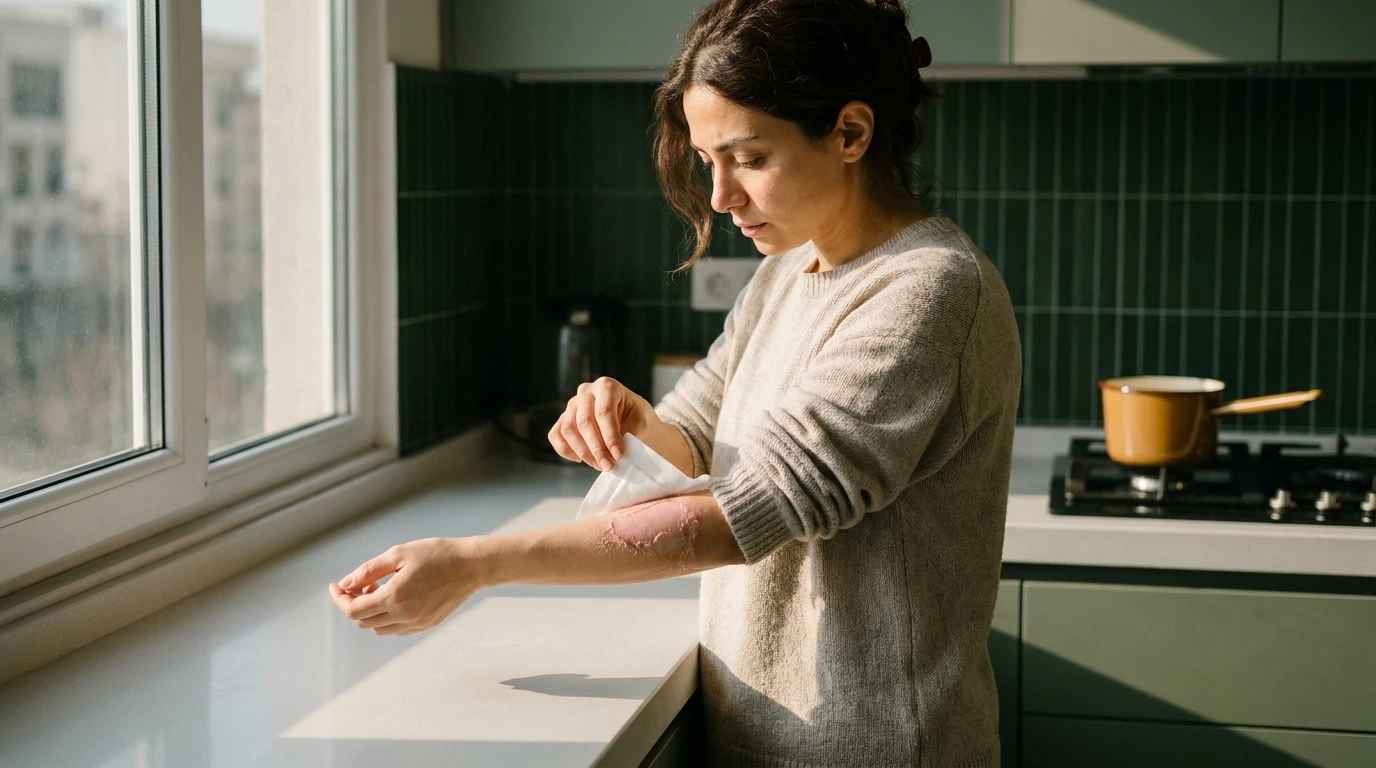
A few days have passed since the burn. On the first day you held it under cool water and covered it. Now every time you open the dressing, something looks different: one day it is weeping, the next a yellow layer has settled on it, a few days later the skin starts lifting, and at night it itches so much you cannot sleep. It is natural to wonder whether it is getting better or worse.
Most of these changes are simply the stages of burn healing: the path skin takes to rebuild itself. A few signs are not normal, though: redness and warmth that spread further from the edge of the burn every day, pus, a bad smell or a fever, pain that gets worse instead of easing, and a wound that is still open after about two to three weeks. Below, we have put what you may see under the dressing in the order it usually appears, so you can find where your own burn is on this path. If you are still in the first hours, read Burn degrees: how to tell how serious it is first.
The stages of burn healing, in plain terms
A superficial (first-degree) burn does not blister. The skin is red and sore for a few days, peels a little and usually heals without a mark. Most of this article is about burns that have blistered (second-degree), which go through three periods:
- The first days: the area is inflamed, red and painful, and the wound weeps.
- The repair period: new skin advances from the edges and rises from the healthy layers underneath. The weeping lessens, the surface peels and the itching begins.
- After the wound closes: the wound is shut, but the colour and texture of the new skin keep changing for months.
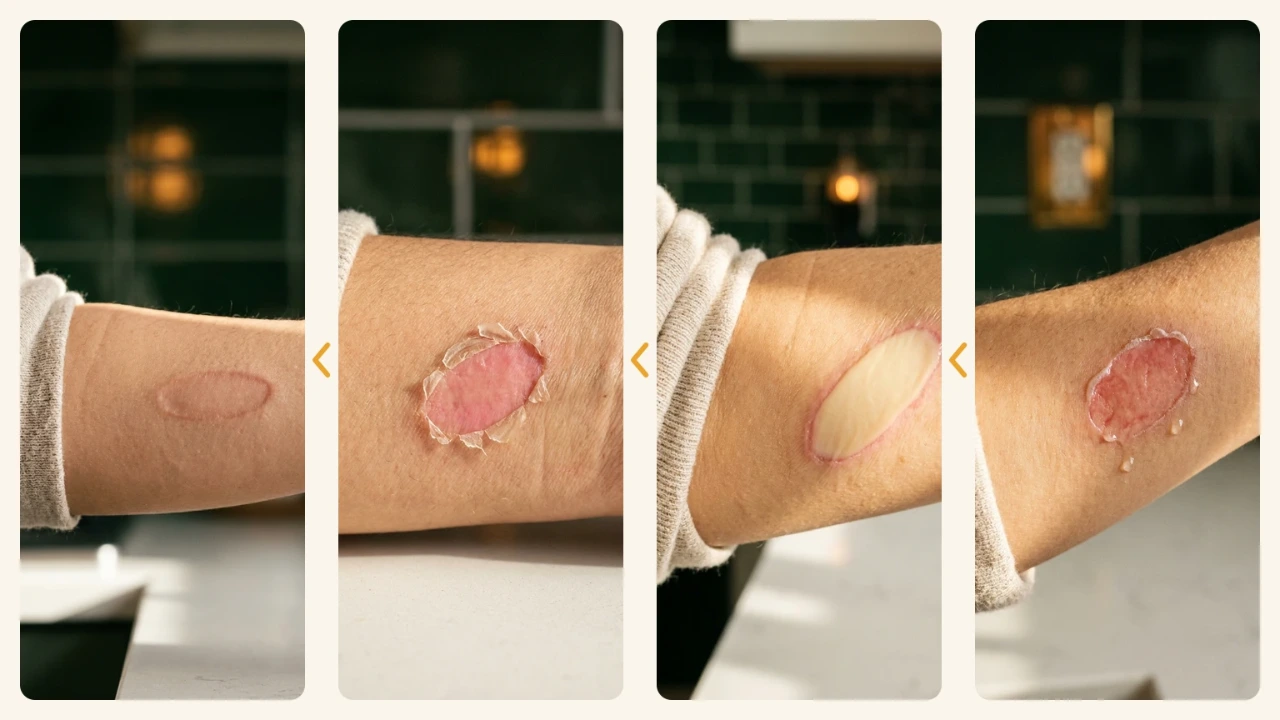
How fast this goes is set by the depth of the burn, not by the calendar. Two burns of the same size but different depth follow two very different paths. That is why we do not give a healing time for a burn we have not seen.
"My burn is weeping"
In a blistered burn, there is a lot of fluid in the first days. The fluid that was inside the blister now seeps from the surface and soaks the dressing. It is usually clear or slightly yellow and thin, has no bad smell, and lessens day by day.
A wet dressing is not a worry in itself. Just change it as often as your doctor told you to, because skin left under moisture for too long becomes soft and fragile. These mean the fluid is no longer normal:
- it has become thick and cloudy, or is turning green or brown;
- it smells bad;
- after the first days, it is increasing instead of decreasing.
"It's gone yellow underneath. Is it infected?"
This may be the most common worry after a burn, and most of the time the answer is no.
A thin pale-yellow or white layer often settles on a healing burn and sticks to the surface of the wound. This layer usually comes from the body itself: proteins that came out with the fluid and stayed on the moist surface. Sometimes it is what is left of a dressing or of an ointment the doctor applied. A layer like this has no smell and does not make the skin around the wound redder or hotter.
Pus is different. It is thick and cloudy, usually smells, and rarely comes alone. The table sets the differences side by side:
| Healing layer | Pus | |
|---|---|---|
| Appearance | thin, pale yellow or white, stuck to the wound surface | thick and cloudy; deep yellow, green or brown |
| Smell | none | often bad |
| Around the wound | redness that is stable or fading | redness and warmth that spread |
| Pain | gradually less | increasing |
| How you feel | well | sometimes fever and chills |
Do not scrub or scrape the healing layer off. New skin is forming beneath it, and pulling the layer away pulls that off too.
Two more points. First, if instead of a yellow layer you see black, hard or leathery tissue over part of the burn, it is probably dead tissue, and the burn was deeper than it looked. Removing it is not a job for home; we explain it in Wound debridement Second, a photo cannot reliably tell a healing layer from pus. If you are unsure, it is better for a doctor to see the wound in person.
"The skin is lifting off"
Once the weeping eases, the roof of the blister (if it is still there) dries, thins and gradually comes away. The surface skin flakes off in small pieces, and underneath appears new skin that is pink, shiny and thin. This is one of the good signs of healing.
Do not peel it, even if it is half detached and bothering you. Skin pulled away before its time takes the new skin under it with it. If it catches on clothing, cover it and show it to your doctor at the next visit.
You can see this exact moment in a real case of a steam burn from Dialine's gallery. At the first session the blister roof has been removed and the surface beneath is moist; by the third session the dry outer skin is coming away and new skin shows underneath.
"Why does it itch so much?"
Itching is a usual companion of burn healing. It starts during the repair period and, for many patients, continues after the wound has closed, sometimes for months. The itch itself is not a bad sign; scratching is what causes trouble. New skin is so thin that a fingernail can break it and reopen the wound.
A few things that help:
- Keep nails short. If the burn is a child's, put thin cotton gloves on them at night.
- Instead of scratching, hold a clean, cool cloth for a few minutes over the dressing or over skin that has closed.
- Once the wound has fully closed, keep the new skin moisturised with a plain, unscented moisturiser, because dry skin itches more. Do not put moisturiser on an open wound.
- Wear loose cotton over the area. Wool and rough fabric, heat and sweat all make the itch worse.
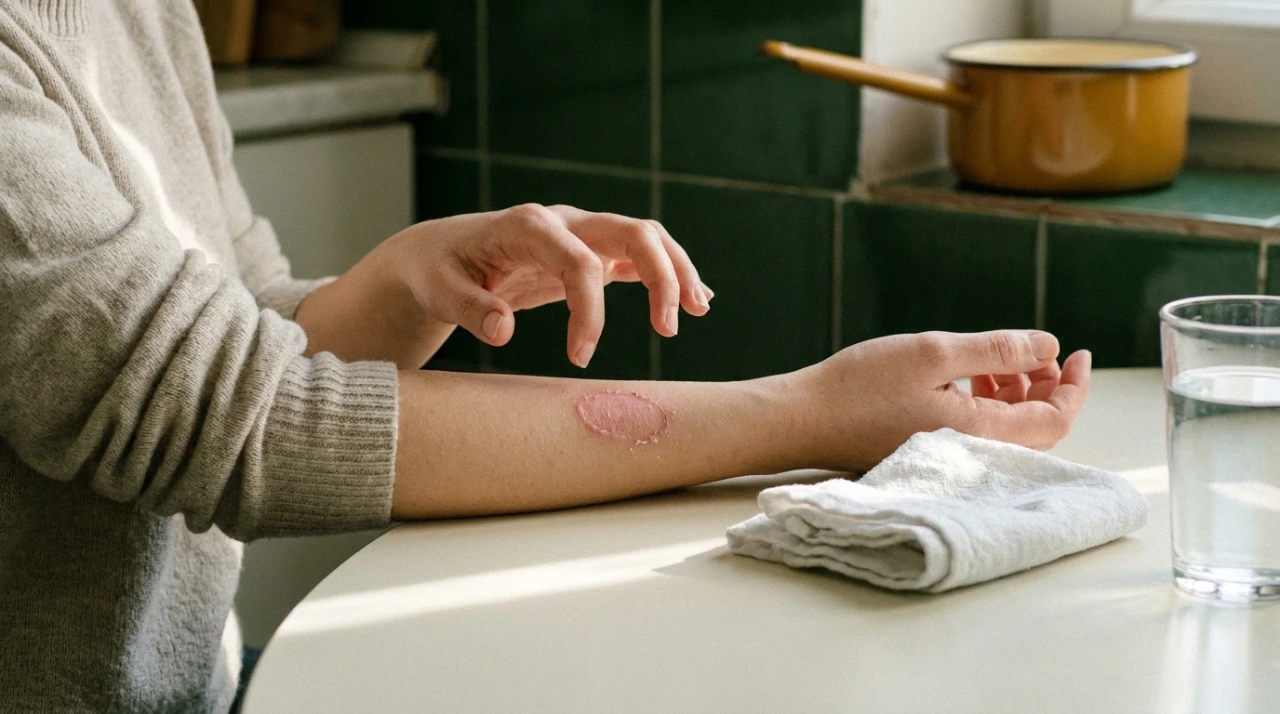
If the itching is costing you or your child sleep, tell your doctor. Itching after a burn can be treated, and you do not have to put up with it. Do not try someone else's medicine either.
"The wound is red, raised and bleeds easily"
Granulation tissue is the red, grainy tissue that fills the base of a wound. Sometimes it grows too much and rises above the surrounding skin. In Persian people call it "extra flesh"; the medical name is hypergranulation. It is shiny, dark red and soft, and bleeds at the slightest touch.
Hypergranulation is not dangerous, but it stops the wound from closing, because new skin cannot advance over it from the edges. Treating it is a doctor's job. At home, do not put anything on it and do not try to shrink it yourself.
"It's closed, but the colour is different"
New skin starts out pink or red, because many new blood vessels have formed beneath it. This redness fades slowly over the following months.
In many Iranian skin types, especially olive and darker skin, the burn area turns brown or darker than the surrounding skin after it closes. Sometimes the reverse happens and a lighter or white patch remains. Both are common after a burn. Darkening usually fades with time; a white patch returns more slowly and sometimes does not return completely.
These changes are slow. A burn mark takes months, and sometimes more than a year, to reach its final colour and texture. So if the colour still differs a few weeks after the wound has closed, that does not mean it will stay that way.
The most important thing you can do is keep the new skin out of the sun: with clothing, and with sunscreen once the skin has fully closed. Sun on new skin makes darkening stronger and longer-lasting. We also cover sun on new skin in Burns on the hands and face.
"The burn mark has become raised and hard"
Most superficial burns heal flat. But sometimes, in the first months after closing, the burn mark gradually becomes raised, firm and red, and itches more. This is called a hypertrophic scar, and it stays within the area of the original burn. A keloid is a different, less common type of scar that grows beyond the edges of the burn onto healthy skin.
Raised scars are more likely after a burn that was deeper or took longer to close. If the burn is over a joint, such as a finger, wrist, elbow, knee or the neck, watch the movement too. Skin that is contracting can make it hard to bend and straighten the joint, and that means a doctor should see it sooner.
A scar that is still young and changing usually responds better to treatment. We explain the methods in Scar treatment: evidence-based methods, and we carry out the assessment at scar treatment at Dialine.
When is it no longer normal?
If you see any of these, do not wait for the next dressing change; have a doctor look at it the same day:
- redness and warmth that have spread beyond the edge of the burn and move further every day;
- pus, foul-smelling fluid, or fever and chills;
- pain that, after the first days, is getting worse instead of better;
- black, hard or leathery tissue on the burn.
This one is not urgent, but it is serious: a burn that is still not closed after about two to three weeks. A burn like that is usually deeper than it first seemed and more likely to scar, so a doctor should see it.
If you have diabetes, do not wait for any of these signs: any burn on a diabetic foot should be seen by a doctor from the first day. We explain why in Foot burns in diabetes. The full list of burn infection signs is in our article on burn degrees.
What to do, and not do, at home in these days
- Wash your hands with soap and water before touching the dressing.
- Change the dressing as your doctor told you. The common belief that a wound should be "left to breathe" is not true for burns: a burn heals better under a clean, suitable covering, and leaving it open and dry does not help.
- If the dressing has stuck to the wound, do not pull it. Soak it with clean water or saline until it softens, then lift it gently.
- Do not peel the flaking skin or the blister roof, and do not scratch the wound.
- Do not put any home remedy on an open wound, from oil and egg yolk to toothpaste and henna.
- Eat enough, especially protein; the body needs it to build new skin. We say more about this in Nutrition and wound healing.
- Do not skip follow-up visits, even when the wound looks healed.
Burn wound care at Dialine
In burn wound treatment at Dialine, in Pasdaran, Tehran, care begins with assessing the degree and extent of the burn, because that assessment sets the course of everything that follows. Then, depending on the wound:
- cleansing and cleaning of the wound;
- removal of dead tissue (debridement) where it is needed;
- advanced dressings matched to the amount of fluid and the depth of the burn;
- watching for signs of infection at every visit, and timely referral;
- care of the burn mark after closing, with silicone gel and sheets and sun protection;
- teaching home care and warning signs.
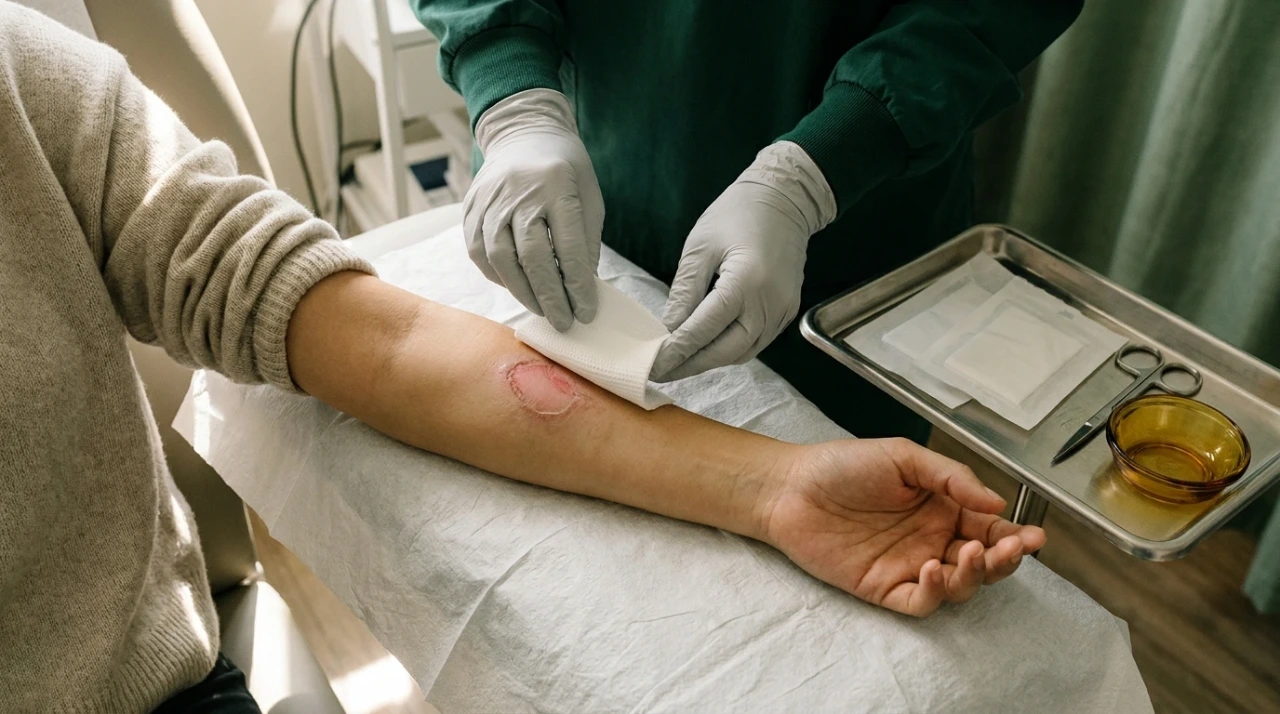
Large or deep burns, and burns in babies and young children, belong in an emergency department or a burn unit, not an outpatient clinic. If you have a burn like that, go straight to the emergency department.
Frequently asked questions
How many days does a burn take to heal?
It depends on its depth. A superficial burn without blisters usually heals within a few days. A blistered burn takes longer, and how long is set by the depth, size and location of the burn and the person's general health. We do not give you a number for a burn we have not seen; but if it is still not closed after about two to three weeks, a doctor should see it.
What is the yellow or white layer on a burn wound?
Most of the time it is a layer from the body itself that settles on the moist surface of a healing wound, and it is not a sign of infection. If it is thick and cloudy, smells, or the redness and pain around it have increased, it may be pus, and a doctor should see it the same day.
Does an itchy burn mean it is healing?
Itching is a usual part of burn healing and is usually not a bad sign. But on its own it does not prove that everything is going well, and scratching damages the new skin. Itching that keeps you awake can be treated; tell your doctor.
Will a boiling-water burn leave a mark?
It depends on the depth of the burn, not on what caused it. A boiling-water burn that is superficial usually heals without a mark. If it blistered, some colour change may remain for a while, and if it was deep or took long to close, a scar is more likely. Proper care in the first weeks and keeping the new skin out of the sun help most.
Why has my burn mark turned dark or white? Will it go back?
After a burn, skin sometimes makes more pigment and turns darker, and sometimes makes less and stays lighter. Darkening usually fades over months, especially if the skin is kept out of the sun. A white patch returns more slowly and sometimes not completely. If nothing has changed after several months, a scar assessment helps.
Why is my burn not healing?
The common reasons are these: the burn was deeper than it looked, it has become infected, dead tissue or hypergranulation is preventing it from closing, there is constant pressure or rubbing on it, or a condition such as diabetes is slowing repair. Each has its own solution, and finding it means the wound has to be seen.
Worried? Let us take a look
If what you see under the dressing does not match any of these descriptions, or you simply want peace of mind, contact Dialine clinic in Pasdaran, Tehran, and book a visit so we can see the burn in person. Dialine works in four areas: diabetes, chronic wounds, scars and neuropathy.
Scientific sources
- ISBI Practice Guidelines Committee. ISBI Practice Guidelines for Burn Care. Burns, 2016.
- World Health Organization. Burns (fact sheet). 2023.
- Deitch EA, Wheelahan TM, Rose MP, et al. Hypertrophic burn scars: analysis of variables. Journal of Trauma, 1983.
- Cubison TCS, Pape SA, Parkhouse N. Evidence for the link between healing time and the development of hypertrophic scars (HTS) in paediatric burns due to scald injury. Burns, 2006.
- Goutos I, Dziewulski P, Richardson PM. Pruritus in burns: review article. Journal of Burn Care & Research, 2009.
- Finnerty CC, Jeschke MG, Branski LK, et al. Hypertrophic scarring: the greatest unmet challenge after burn injury. The Lancet, 2016.
This article is not a substitute for an in-person medical consultation.