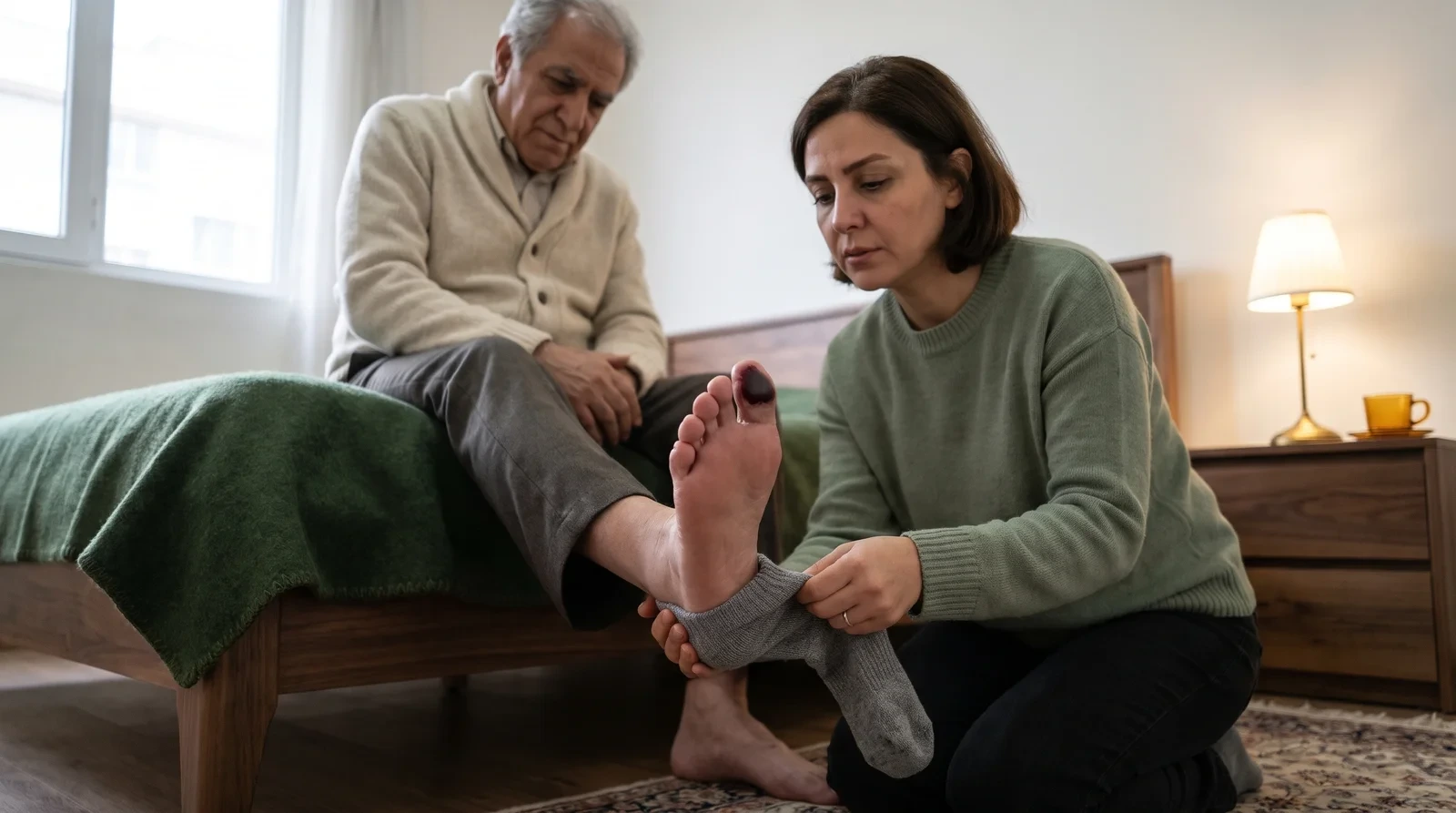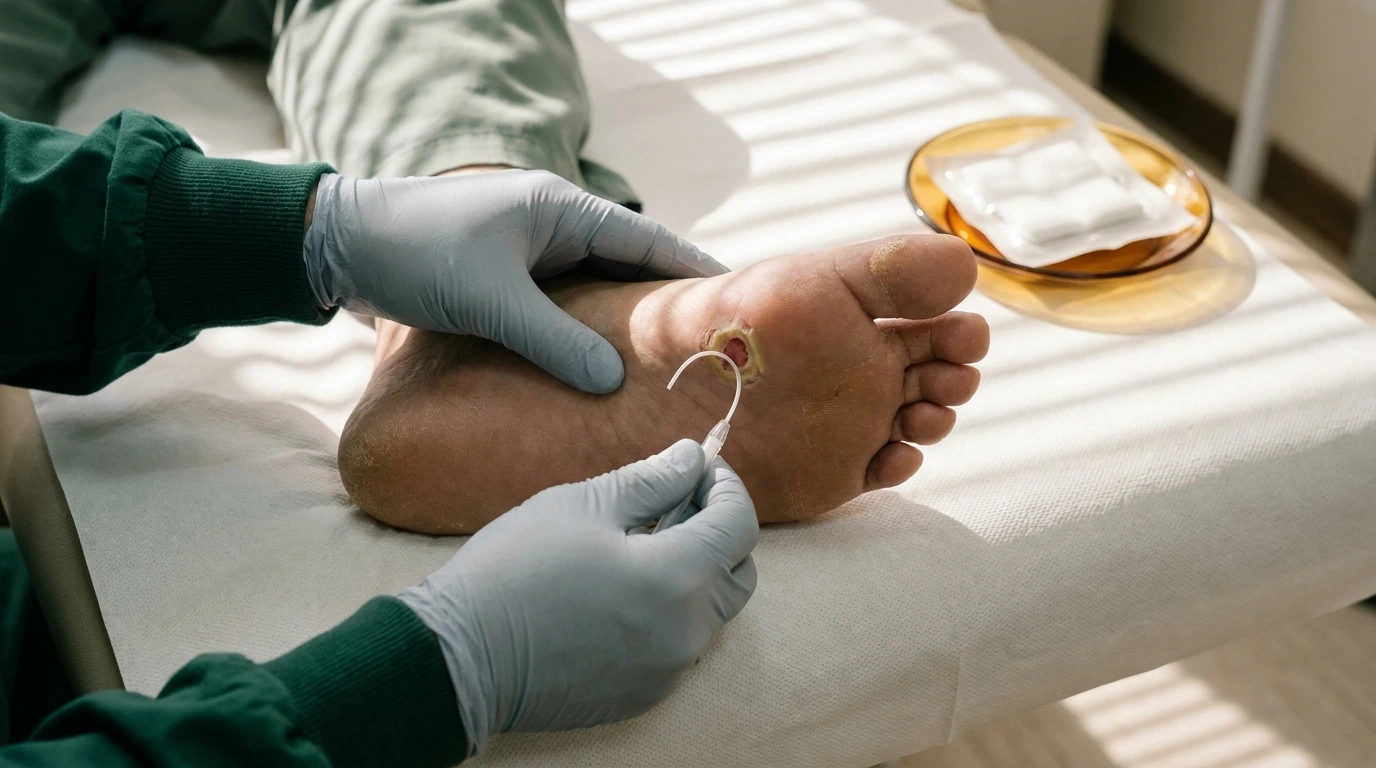
A diabetic foot ulcer rarely opens overnight. It usually begins as a callus that has darkened in the middle, a blister rubbed up by a shoe, a crack in the heel, or a red patch that does not fade after the shoe comes off. Many people with diabetes have lost some feeling in their feet, so all of this is often painless and noticed late.
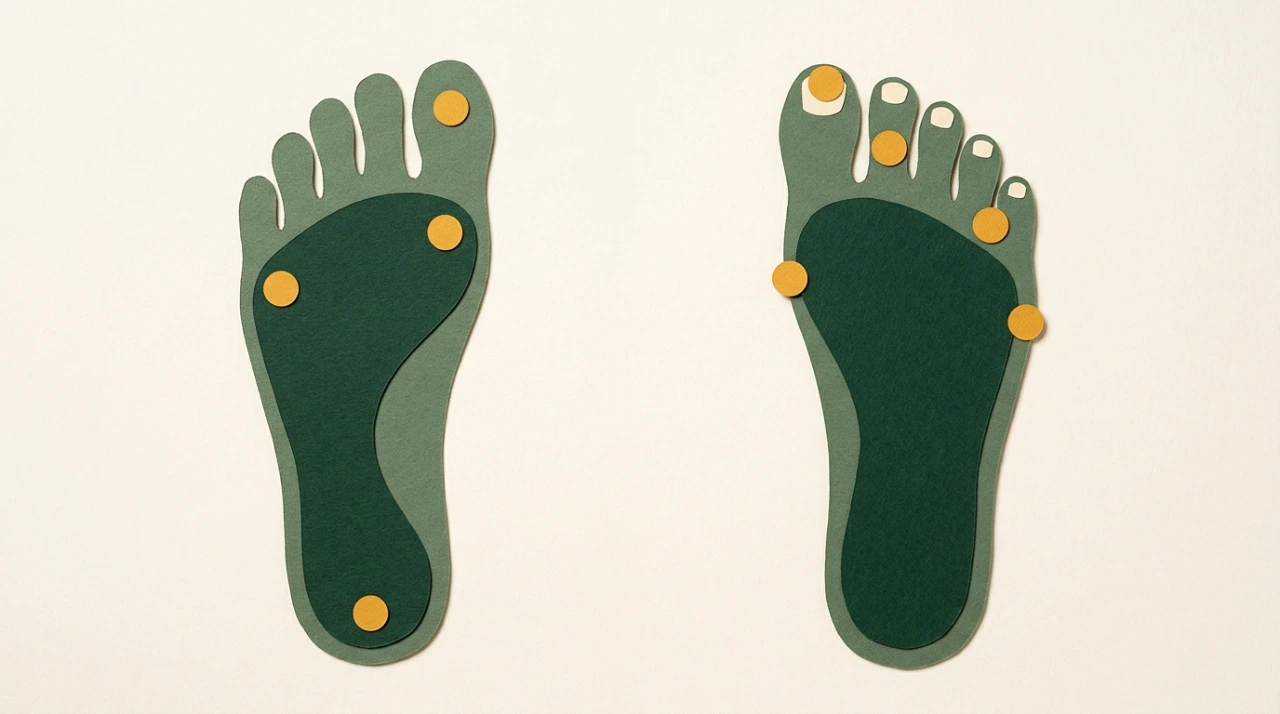
The short answer: diabetic foot ulcers usually start where the foot takes the most pressure or rubbing. That means the ball of the foot, under and at the tip of the big toe, the tops and tips of the toes, the heel, between the toes, and the sides of the foot. The typical ulcer is a round or oval crater ringed by hard, yellowish callus, and it often does not hurt. If you find something like this, take the pressure off it, cover it cleanly, and call a doctor today. Dialine treats diabetic foot ulcers at its clinic in Pasdaran, Tehran.
Where a diabetic foot ulcer usually starts
An ulcer opens where the skin has been under pressure or friction again and again. A foot without feeling gives no warning of that pressure, so its owner never changes the way they walk or the shoe they wear. These are the most common sites:
- The ball of the foot, under the bony prominences: this is where most of the body's weight lands during walking.
- Under and at the tip of the big toe: the big toe pushes the foot off the ground at every step and takes a lot of pressure.
- The tops and tips of bent toes: a toe that has curled (a hammer toe) knocks against the top of the shoe and presses its tip into the ground.
- The heel: the heel is more likely to break down in someone who has been lying down for long periods, or whose heels have deep cracks.
- Between the toes: moisture that lingers softens the skin and makes it fragile, and this is the place least often looked at.
- The sides of the foot: beside the big toe and beside the little toe, exactly where a tight or new shoe rubs the skin.
Before an ulcer opens
Some signs are not ulcers yet, but left alone they become one. The International Working Group on the Diabetic Foot (IWGDF) treats dealing with these signs as part of ulcer prevention:
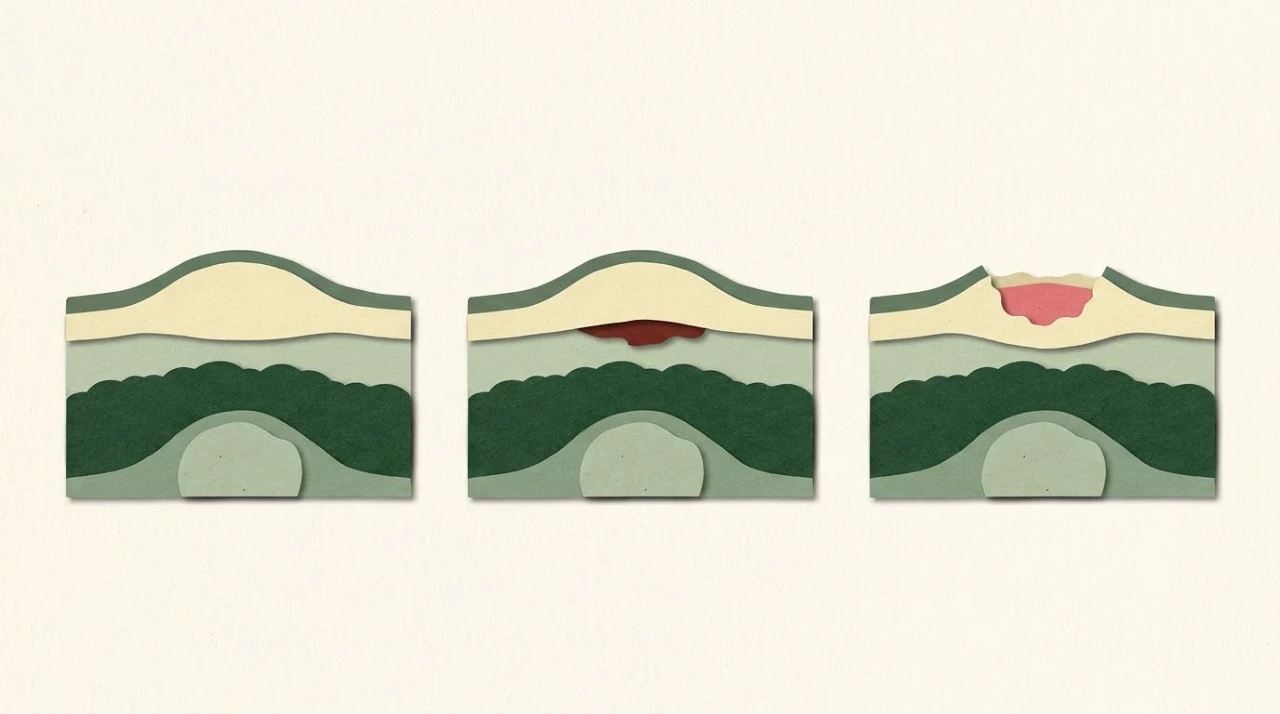
- A callus that has turned dark, brown or bloody in the middle: it means there has been bleeding under the callus. Sometimes an ulcer has already formed beneath it and cannot be seen from outside.
- A blister at a pressure point: the shoe or sock has separated the top layer of skin from the layer below. Once the roof of the blister comes off, the wound is open.
- A heel crack: a crack that is still superficial but getting deeper every day. A crack that bleeds is, in practice, already a wound and a way in for germs.
- Redness or warmth that does not go away: if a spot is still red some time after the shoe comes off, the pressure there has been more than the skin can take.
Do not shave or pop any of these yourself. Calluses and blisters on a diabetic foot are a job for the care team. Which parts of the foot to look at each day, and how, is covered in our step-by-step guide to daily diabetic foot care.
There is one more sign that involves no wound at all but is urgent: a foot that has become red, warm and swollen for no clear reason, even if it does not hurt. A doctor should see that foot the same day.
What an open ulcer looks like
A diabetic foot ulcer does not have a single appearance. It depends mostly on the underlying cause, that is, whether the foot has lost sensation or lost blood supply, and many people have both. Depth changes the picture too.
An ulcer ringed by callus
This is the most common form. At a pressure point, usually the sole or under the big toe, there is a round or oval crater whose edge is a hard, yellowish ring of callus. The base of the wound is often pink or red, the foot is warm, and the ulcer hurts little or not at all. That lack of pain is exactly why people keep walking on it.
An ulcer on a cold foot
When too little blood reaches the foot, ulcers tend to appear on the tips of the toes, the edges of the foot or the heel. The surrounding skin is pale or bluish and the foot feels cold. The base of the wound is less often red and more often pale, yellow or black. Unlike the first type, this ulcer may be painful, especially at night or when the foot is raised. Until the foot's blood supply has been assessed, an ulcer like this will not heal.
Superficial, deep, infected, black
| What you see | What it means | When a doctor should see it |
|---|---|---|
| A shallow crater with a pink or red base | Only the upper layers of skin are gone | Within a day or two |
| A crater that reaches below the skin; sometimes tendon or bone is visible | The ulcer is deep | The same day |
| Redness and swelling spreading around the wound, warmth, pus or a bad smell | Possible infection | The same day |
| Black tissue on the wound, or a toe that has turned black | Tissue has died | The same day; with a fever, it is an emergency |
The colour of the wound bed tells you something as well. Red usually means living tissue that is healing. Yellow and sticky, or black, means dead tissue that has to be removed; we explain that in What is wound debridement?
Why it does not hurt, and why that is not good news
Over years, high blood sugar damages the nerves of the feet. This damage is called neuropathy. A foot that has lost its sense of pain gives no warning: a pebble in the shoe, a shoe that rubs, an ulcer that has opened, none of them is felt. So do not take the absence of pain as a sign that the ulcer is minor.
We cover the nerve damage itself in Diabetic peripheral neuropathy, and you can see an example of the same painlessness in Foot burns in diabetes.
What it gets mistaken for
Not everything seen on a diabetic foot is a diabetic ulcer. But on a diabetic foot, none of these should be taken lightly:
- Fungal infection between the toes: white, wet, peeling skin that itches. It is not an ulcer in itself, but its cracks are a way in for germs.
- A dry heel crack: a superficial crack that does not bleed usually improves with moisturising the heel. A deep or bleeding crack should be seen by a doctor.
- An ingrown toenail: the skin beside the nail turns red and swollen. On a diabetic foot it gets infected quickly.
- Bruising after a knock: a bruise under a nail or on a toe usually fades gradually. A dark area that keeps growing, or a toe that has gone cold, is not a simple bruise.
Telling these apart takes an examination, not a photo. With diabetes, any break that opens in the skin of the foot can be a way in for infection.
If you have found something today
- Take the pressure off. Until a doctor has seen the wound, walk less and do not wear the shoe that touches that spot.
- Cover it cleanly. Rinse the wound gently with clean water or sterile saline, pat it dry with clean gauze, and put a dry sterile dressing over it.
- Do not put anything on it. Ointments, powders, honey, turmeric or any other home remedy hide the colour and shape of the wound and can contaminate it. Do not pop a blister and do not shave a callus.
- Take a photo. One photo a day, in the same light and from the same distance. The photos are for comparing one day with the next, not for diagnosis at a distance.
- Book a visit. Call today. A new ulcer on a diabetic foot should be seen by a doctor within a day or two.

If the wound comes with a fever, spreading redness and swelling, a bad smell or blackening, do not wait for an appointment. The full list of these signs is in Signs that need urgent care.
How we treat it at Dialine
At the first visit we examine more than the wound: we also assess sensation in the foot, its blood supply and any signs of infection, because the look of an ulcer alone does not reveal its cause. Then, depending on the wound:
- Specialised debridement to remove the callus around the wound and any dead tissue.
- Offloading, taking pressure off the wound with suitable footwear or a device. Without it, even the best dressing does not work.
- Modern dressings matched to the discharge and the stage of healing.
- Infection control, with a wound culture when needed.
- Vacuum therapy (NPWT), ozone therapy, larval therapy and PRP for wounds that need them.
- Home wound care, when coming to the clinic is difficult for the patient.
Real diabetic foot ulcers treated at Dialine are documented session by session in our diabetic foot ulcer gallery. How the right shoes and insoles take pressure off is explained in Medical footwear and insoles for people with diabetes. The full service is described on our chronic and diabetic wound care page.
Frequently asked questions
Does a diabetic foot ulcer hurt?
Often not, and that is where the danger lies. Most of these ulcers open on a foot that has lost some feeling. If an ulcer that did not hurt becomes painful, or the foot starts aching at night, call before your scheduled appointment. Either can be a sign of infection or poor blood supply.
Does a diabetic foot ulcer itch?
Mild itching around a wound that is healing is common. Itching between the toes with white, wet skin points more towards a fungal infection. But if the itching comes with spreading redness, warmth or discharge, tell your doctor. Do not scratch the wound, and do not lift the dressing to scratch.
Is a diabetic foot ulcer contagious?
No. A diabetic foot ulcer does not pass from one person to another. An infected wound does carry germs, though, so wash your hands before and after changing the dressing, and throw the old dressing away in a separate bag.
How can I tell a callus from an ulcer?
A callus is hard, yellowish skin with a closed surface. If its centre has turned dark or bloody, or fluid is coming from it, there is probably an ulcer underneath. Do not test this by shaving it. A doctor removes the callus and looks underneath.
What does a wound between the toes mean in diabetes?
Most often, moisture or a fungal infection has softened the skin and split it, and sometimes the toes are pressing against each other. With diabetes this split can become infected, and because it is out of sight, it is found late. After washing, dry carefully between the toes and do not put cream there. An open wound should be seen by a doctor.
Why is the skin around a sole ulcer hard and yellow?
That ring is callus, and it shows the spot is still under pressure. The callus hides what is underneath and stops the wound edges from closing, which is why it is removed as part of treatment. Removing it is a job for the care team, not for a blade or a pumice stone.
Will a diabetic foot ulcer heal?
Treated early and properly, a diabetic foot ulcer closes without amputation in most cases. How long it takes depends on the depth of the wound, infection, blood supply, blood sugar and taking pressure off the wound, as we explain in How long does diabetic foot ulcer treatment take?
Free consultation
If you have found something like this on your own foot or a family member's, keep today's photo and get in touch. Dialine's team in Pasdaran, Tehran, will help you work out how soon we should see the wound. Dialine works in four areas: diabetes, chronic wounds, scars and neuropathy.
References
- Bus SA, Sacco ICN, Monteiro-Soares M, et al. Guidelines on the prevention of foot ulcers in persons with diabetes (IWGDF 2023 update). Diabetes/Metabolism Research and Reviews, 2023.
- Monteiro-Soares M, Hamilton EJ, Russell DA, et al. Guidelines on the classification of foot ulcers in people with diabetes (IWGDF 2023 update). Diabetes/Metabolism Research and Reviews, 2023.
- Senneville É, Albalawi Z, van Asten SA, et al. IWGDF/IDSA guidelines on the diagnosis and treatment of diabetes-related foot infections (IWGDF/IDSA 2023). Diabetes/Metabolism Research and Reviews, 2024.
- Armstrong DG, Boulton AJM, Bus SA. Diabetic foot ulcers and their recurrence. New England Journal of Medicine, 2017.
This article is not a substitute for an in-person medical consultation.